Crafting a Realistic Burger Paper Sculpture
There is something undeniably satisfying about transforming a flat sheet of paper into a three-dimensional object that mimics real life. A Burger Paper Sculpture takes this concept to a delicious extreme, offering a whimsical yet sophisticated way to explore papercrafting. Unlike traditional models that might focus on architecture or animals, this project centers on a universally recognized icon of food culture. The result is a minimalist, modern decoration that can serve as a striking centerpiece for a party, a playful lunch display, or a unique piece of kitchen art. Whether you are looking to fill a quiet afternoon with creativity or need a custom prop for a commercial shoot, this craft bridges the gap between simple hobbying and professional design.
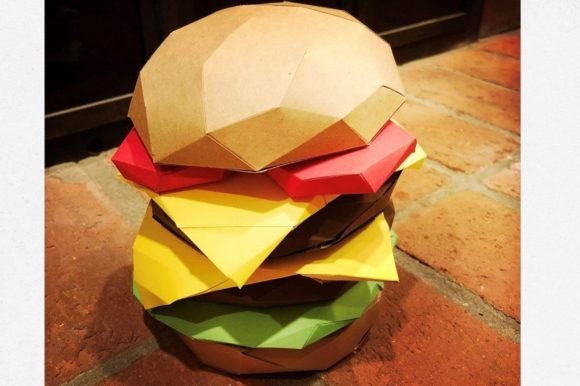
At its core, this project involves assembling layered components to replicate the structure of a classic burger. From the sesame seed bun to the lettuce, cheese, patty, and tomato, each element is cut, scored, and glued to create depth and texture. The beauty of this specific template, created by Sofs Design, lies in its versatility. It is not just a toy; it is a design asset. The files provided typically include both PDF and SVG formats, ensuring compatibility whether you are cutting by hand with a craft knife or using a digital cutting machine like a Cricut or Silhouette. This dual-format approach acknowledges that crafters have different tools and comfort levels, making the project accessible to a wide demographic.
Why This Project Resonates Across Different Creators
The appeal of a paper burger extends far beyond simple aesthetics. Different people engage with this project for vastly different reasons, driven by their specific goals and backgrounds.
For the beginner hobbyist, the primary draw is often the low barrier to entry. Papercraft requires minimal investment; you likely already have scissors, glue, and some cardstock at home. The process of scoring lines and folding tabs provides a tactile learning experience that teaches patience and precision without the frustration of more complex mediums like clay or woodworking. Completing a burger sculpture offers an immediate sense of accomplishment because the subject matter is so familiar—you know instantly if it looks "right."
Conversely, an experienced creator or professional designer might view this template as a foundation for customization. The inclusion of SVG files is critical here. It allows a graphic designer to open the vector paths in software like Adobe Illustrator, tweak the proportions, change the patterns on the bun, or alter the color palette to match a specific brand identity. For a marketer planning a food festival or a restaurant launch, having a scalable, physical prop that can be reproduced endlessly is invaluable. They aren't just making a craft; they are producing marketing collateral.
Educational and Commercial Applications
In an educational setting, such as a classroom or a workshop, this project serves as an excellent tool for teaching geometry and spatial reasoning. Educators can use the assembly process to explain how 2D nets transform into 3D volumes. Students learn about structural integrity—why certain folds add strength and how glue placement affects stability. It turns a fun activity into a stealth lesson on engineering principles.
For small business owners and entrepreneurs, particularly those in the event planning or photography sectors, the utility is clear. Food photography often requires perfect, untouched subjects. Real food melts, wilts, and loses color under hot lights. A paper sculpture, however, remains pristine indefinitely. A photographer can style a "meal" that looks appetizing in photos without worrying about spoilage. Similarly, an event planner can create a themed tablescape for a brunch or birthday party that is durable enough to survive the event yet cheap enough to be disposable or reusable.
Practical Considerations for Success
While the concept is straightforward, the quality of your final Burger Paper Sculpture depends heavily on material choices and technique. The template instructions often recommend specific paper weights, such as 65 lb to 80 lb cardstock (around 216 gsm). This range is crucial. Paper that is too thin will lack the rigidity needed to hold the burger's shape, resulting in a saggy, unappealing model. Paper that is too thick may be difficult to score and fold cleanly, leading to cracked edges.
When selecting your supplies, consider the finish of the paper. A matte finish often looks more realistic for food items, reducing the plastic-like sheen that glossy paper can create. Encore Cardstock, for instance, is frequently cited in these templates for its consistent weight and texture, providing a reliable base for coloring or printing.
The construction process itself demands attention to detail. If you are cutting by hand, a sharp craft knife and a self-healing cutting mat are essential for clean edges. Dull blades tear the paper fibers, ruining the crisp look of the lettuce or the bun. Scoring is perhaps the most important step; using a ruler and a blunt tool to indent fold lines before creasing ensures sharp, professional-looking corners. Rushing this step often leads to uneven folds that compromise the structural symmetry of the burger.
- Precision Cutting: Whether using a machine or hand tools, ensure every curve of the bun and every jagged edge of the lettuce is smooth.
- Adhesive Choice: Glue sticks and double-sided tape are preferred for their cleanliness and lack of warping. White glue can work but must be applied sparingly to avoid soaking the paper.
- Scaling: One of the greatest advantages of digital templates is scalability. You can resize the SVG or PDF files equally to create a giant burger for a store display or a miniature version for a dollhouse or jewelry charm.
Tailoring the Project to Your Needs
Deciding whether this project fits your current needs comes down to evaluating your priorities: speed, cost, creativity, or durability.
If speed is your priority, utilizing a cutting machine with the provided SVG files will drastically reduce production time. You can churn out multiple units for a large event in a single afternoon. If cost is the main factor, hand-cutting with basic office supplies keeps expenses near zero, requiring only the initial purchase of the template.
For those focused on creativity, the template acts as a canvas. You are not bound to a standard beef burger. You can experiment with different paper colors to create a vegan black bean burger, a breakfast burger with egg layers, or even a fantasy burger with neon ingredients. The modular nature of the design encourages experimentation.
Ultimately, the value of a Burger Paper Sculpture lies in its adaptability. It is a low-risk, high-reward project that satisfies the human desire to make things with our hands while delivering a result that sparks joy and conversation. Whether it ends up as a quirky gift for a burger-loving friend, a permanent fixture in a eclectic kitchen, or a key element in a professional portfolio, the effort put into crafting it yields a tangible, lasting impact. By understanding the materials and respecting the process, creators of all skill levels can produce a piece of art that is as satisfying to make as it is to behold.